
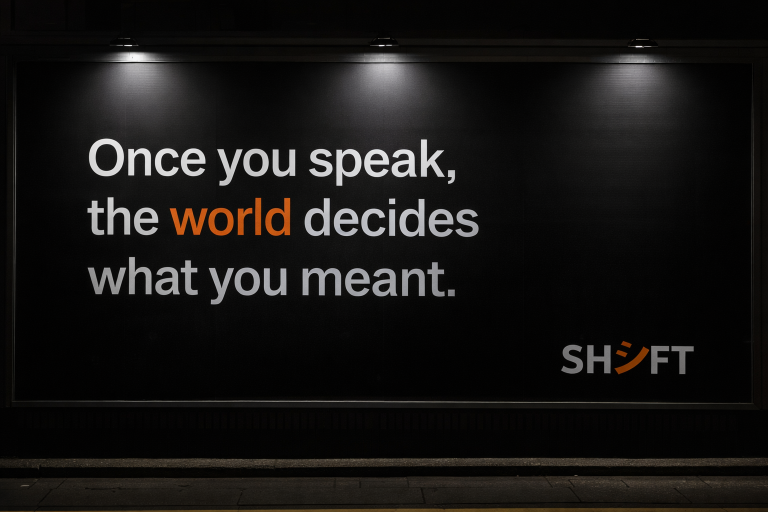
Most systems still infer.
They infer from behaviour, profiles, clicks, searches, CVs, applications, posts, forms, and partial signals.
That works until the guess is wrong.
A candidate becomes a keyword match.
A customer becomes a segment.
A worker becomes a utilisation rate.
A person becomes data exhaust.
SHシFT brings meaning forward before systems classify, match, reject, recommend, optimise, or automate.
The problem
Modern systems act before they understand.
People are interpreted before they declare what matters.
Organisations act before they declare what they are really trying to solve.
So both sides waste effort.
People are misread.
Teams solve the wrong problem.
Recruiters chase false fit.
AI generates answers before meaning is clear.
The result is not just wrong output.
It is wrong framing at scale.
What SHシFT does
SHシFT creates a declared-meaning layer between people and the systems trying to act on them.
People declare:
what they mean
what they want
what they do not want
what conditions matter
what would make something wrong
what can be acted on
what requires consent
Organisations declare:
what problem they are solving
who they need to reach
what they are assuming
what would make this a wrong match
what permission they need before acting
A meaning record on one side.
An intent record on the other.
Permissioned fit between them.
Not a profile.
Not a survey.
Not behavioural exhaust.
The SHシFT Constraint
Before action, define:
What outcome is required?
Why now?
Under what conditions?
What would make this wrong?
What requires permission?
If this is unclear, everything downstream is guesswork.
Why now
Applications, outreach, leads, content, recommendations, and decisions can now be generated at near-zero effort.
Activity scales.
Waste scales faster.
The next AI bottleneck is not output.
It is declared input.
When expression becomes abundant, the scarce asset is what generated words cannot prove:
what someone actually means, under what conditions, with what constraint, timing, permission, and consequence.
Where SHシFT becomes measurable
SHシFT can apply anywhere systems act on weak human signal.
Briefs. Hiring. Demand. AI agents. Introductions. Customer understanding. Public services.
One early proof market is constrained hiring, because misread fit already has visible cost.
A candidate can look perfect on paper and still be impossible to place.
A role can look attractive and still be wrong.
SHシFT brings the missing conditions forward before systems screen, match, progress, reject, or automate.
Where declared meaning matters
Hiring & Recruitment → First proof market
Match against declared intent, not inferred fit.
AI / Agentic Systems →
Give machines explicit context before optimisation.
Agencies / Demand-led Strategy →
Identify emerging demand before the brief exists.
Reform Signal →
Surface serious reform capability before institutions mistake noise, status or ideology for signal.
Healthcare / Clinical Systems →
Reduce ambiguity before automation and decision pathways begin.
Structured introductions →
Consent-gated, context-rich contact.
Salesforce / RevOps →
Systems built on decisions, not interpretation.
Insurance & Claims Systems →
Reduce interpretation drift before risk, claims, and automation decisions scale it.
The payoff
Fewer wrong matches.
Fewer wasted approaches.
Fewer false positives.
Fewer rebuilds.
Fewer systems acting on guesses.
Not faster.
Truer before faster.
SHシFT what you mean.
Before the world guesses.
info@getshift.me
s7t labs ltd
SHシFT everything
Registered in England and Wales, Company Number: 15663366
PRIVACY NOTICE:
Your personal data is safe - we don't want it.
Your personal data is safe - we don't want it.